
The European Union's EN 18869-5:2007 standard still included testing of the separation efficiency of the aerosol separator used to treat aerosols in commercial kitchens.
The draft standard prEN 16282-6, which replaced this standard, also included testing of separation efficiency; however, this requirement was removed from the published a
It cannot be a coincidence that testing for separation efficiency was omitted from the new standard, since the particle size distribution of kitchen aerosols can vary greatly depending on the cooking equipment, the cooking process, the type of kitchen operation (cafeteria, restaurant, etc.), and the distance from the source. Thus, it is difficult to uniformly assess the separation efficiency percentage of a specific aerosol separator.
Aerosol separators in the kitchen are baffle separators, in which the flow is deflected around curves or obstacles (e.g., baffle plates) so that the particles, due to their inertia, cannot follow the flow lines. If the inertial forces are also utilized through radial deflection, this is called centrifugal separation.
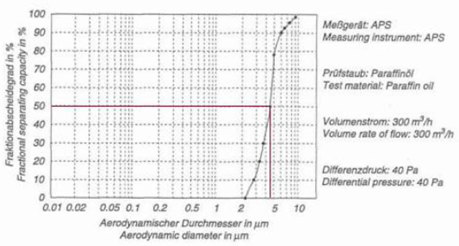
The figure below shows the fractional separation degree of a typical market aerosol separator. [1]
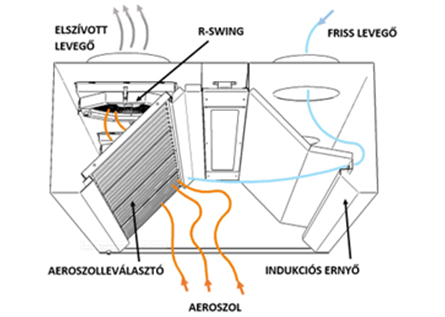
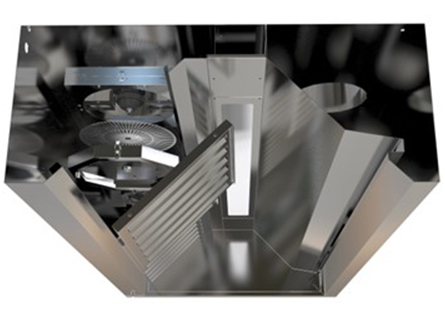
When some manufacturers of aerosol separators on the market claim that their product has a separation efficiency of 99.999%, it is difficult to correlate this with particle size. Experience shows that, downstream of the separators, the exhaust system is still exposed to a significant grease load. To eliminate this, we have integrated a rotating disc into the hood’s exhaust connection downstream of the separator, with the aim of centrifugally removing residual grease and oil droplets. The flame-resistant aerosol separator, compliant with standard EN 18869-5:2007 (marking “A”) and EN 16282-6:2020 (marking “F1”), respectively, and the R-Swing rotating disc are integrated into an induction exhaust hood manufactured by us from stainless steel. The incoming fresh air is cooler than the exhaust air, causing gaseous molecules to condense on the surface of the separator and the rotating disc, thereby enhancing separation. The high-speed rotating disc sets the air in a rotational motion, and the increase in speed is accompanied by a decrease in pressure, which also contributes to the condensation of gaseous molecules.
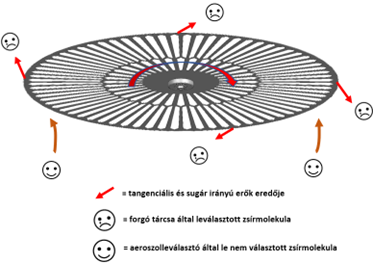
The motor that drives the disc is integrated into the hood’s exhaust connection. In our experience, the rotation speed significantly affects the disc’s capture efficiency. The reason for this increase is that, at a higher rotation speed, particles are more likely to strike the disc. The disc’s spokes, made of stainless steel, capture them. Due to the high rotational speed, centrifugal force moves the captured particles toward the ends of the spokes. Grease and oil are collected along the circumference of the support frame and can be easily removed without frequent maintenance. An ideal rotational speed is considered to be approximately 2,200 revolutions per minute. At lower air velocities (2–3 m/s), the particles move more slowly in the flow carrying them, allowing for a longer contact time with the disc spokes and, thus, a higher capture rate. Translated with DeepL.com (free version)
The EN 16282-6:2020 standard stipulates that, for thermal cooking equipment, only an aerosol separator tested for flame penetration may be used. Therefore, if the R-Swing manufactured by us is not installed in a hood produced by us, then a flame-resistant aerosol separator must be installed upstream of the R-Swing.
Reference: [1] DMT (TUV NORD GROUP), Aerosol_separators_web