
source: https://ors.od.nih.gov/sr/dohs/Documents/cold-room-mold.pdf
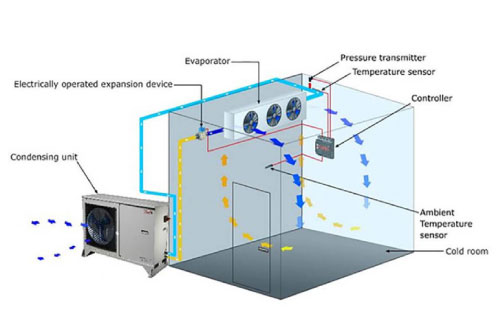
The axonometric diagram below illustrates the cooling process in a cold storage facility. Most cold storage facilities and cold rooms have a closed ventilation system. The air is recirculated and remains inside the room. The evaporator fans blow cold air. As it circulates through the room, it warms up slightly and returns to the evaporator, where it is cooled again. The cycle begins anew.
Usually, opening the door is the only way for fresh air to enter the room. The warm air that enters causes condensation to form on cold surfaces, creating conditions conducive to mold growth.
Mold spores are everywhere around us: in the air we breathe, on surfaces, both indoors and outdoors, with the exception of the North and South Poles. From an ecological perspective, mold plays an important role in the decomposition of organic matter. For mold to grow, it needs a surface, a source of nutrients, and moisture. In cold storage facilities, warm air that condenses on cold surfaces provides a suitable environment for mold growth.
Mold does not only appear on the interior walls of cold storage facilities and storage areas, but also on the surface of stored fruits and vegetables. This is a complex problem, and its control must be planned comprehensively. With our R-FILTER equipment, we recommend a protection method that uses ozone gas and UV-C light.
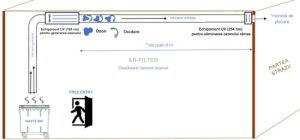
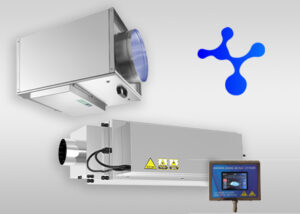
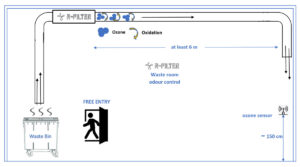
Suspended from the warehouse ceiling, 2–3 meters in front of the evaporator fans, we install so-called UV lamp frames so that they offer as little resistance as possible to the recirculated airflow. We use UV lamps that also produce ozone. The combined use of UV-C light and ozone delivers a double blow to mold spores in the air. Thanks to recirculation, the ozone gas reaches every corner of the warehouse, as well as the surface of the stored fruits and vegetables, to prevent mold growth.
Ozone gas is also effective at removing ethylene released during the ripening of produce stored in fruit and vegetable storage facilities. If this gas accumulates, the fruit and vegetables ripen rapidly, leading to a decline in quality and a shorter shelf life.
UV-C light emitted at 254 nm has proven to be extremely effective in destroying molds (Aspergillus niger, Aspergillus fumigatus, Microsporum canis, Epidermophyton floccosum, Trichophyton rubrum), as the light covers the entire environment where the lamp is used, allowing for the disinfection of a large volume of air. The guarantee of applying the required radiation dose is that the evaporator fans continuously circulate the air through the UV frames. UV light emitted at 185 nm produces ozone, which destroys mold. Ozone in the air can reach where UV-C light cannot penetrate.
- 0.1 ppm (0.2 mg/m3) for an 8-hour working day
- 0.2 ppm (0.4 mg/m³) for up to 15 minutes
The key to ensuring the necessary ozone concentration for ozone-based mold destruction is that the evaporator fans run 24 hours a day, and the R-FILTER equipment operates in parallel with them, so that mold spores are repeatedly exposed to ozone during recirculation, and ozone continuously reaches all surfaces in the warehouse.
The warehouse must be equipped with enough ozone-generating UV lamps so that, at the lower level of the warehouse, the ozone concentration measured over a 24-hour period does not exceed 0.1 ppm. At this concentration, warehouse staff may use the entrance, as the concentration does not exceed the permissible level for them even during an 8-hour work shift. For safety, an ozone concentration detector must be installed at a height of 150 cm at a key location, which shuts off the ozone-generating lamps when the concentration exceeds 0.1 ppm. It is essential that there be a mandatory interconnection between the evaporator fans and the R-FILTER equipment. If the evaporator fans are not running, the equipment cannot operate either!