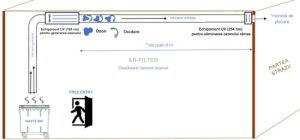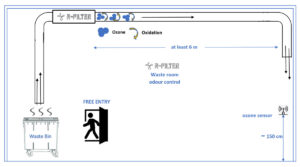

In the design of new professional kitchens, an important topic is the post-treatment of aerosols in the exhaust air, for which we have developed innovative solutions using UV-ozone technology.
Our treatment is a post-treatment, as the grease-contaminated exhaust air already has a pre-treatment above the cooking station, in the kitchen hood, with the aerosol separator.
Our UV-ozone technology, as a post-treatment, is based on the photolysis of short-wavelength UV radiation and the chemical oxidation reaction (ozonolysis) of ozone (O3), generated from atmospheric oxygen (O2), with organic particles.
Photolysis is a photochemical decomposition process in which organic molecules (grease and odors) are decomposed by photons under the action of UV-C light.
Ozonolysis is the oxidation process of photodegraded molecules exposed to the action of ozone produced by UV lamps.
The technology prevents the accumulation of oil and grease residues in the exhaust system and the associated fire risk.
We have developed two types of systems:
Aerosol post-treatment system (UVS), installed in the kitchen exhaust duct, and aerosol post-treatment system (UVO-C), placed outside the exhaust airflow.
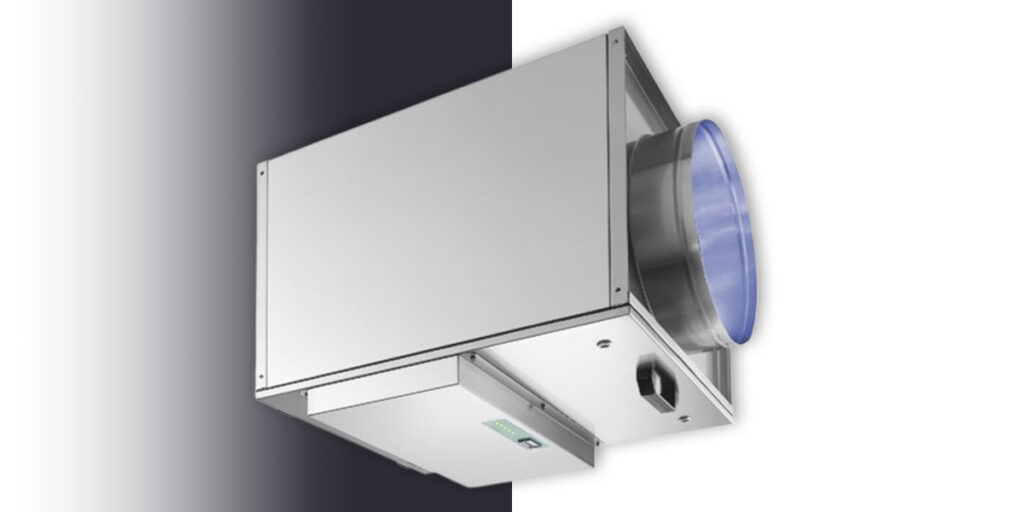
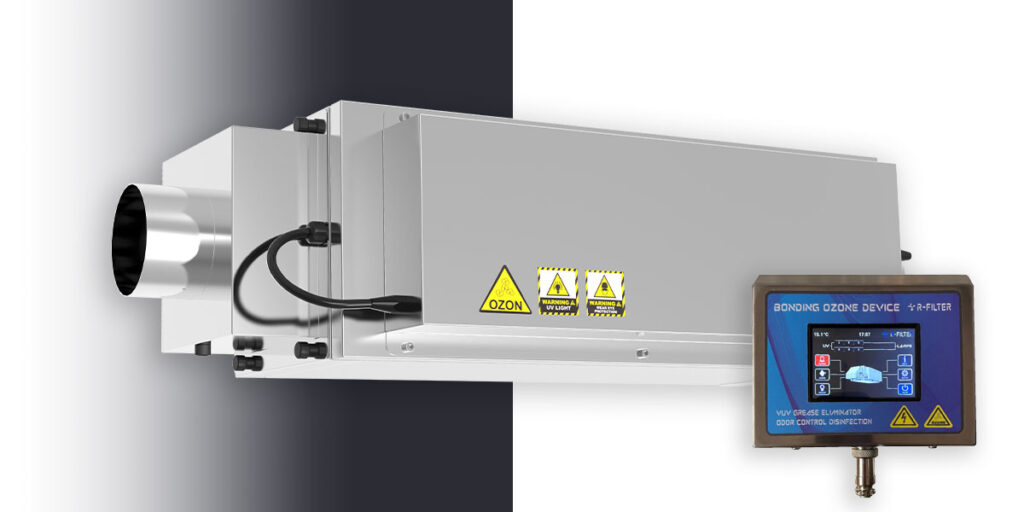
When using the above air purification system, the requirements of the EN 16282-8:2017 standard must be observed:
A.6.3 Protection against UV light
The UV equipment in the open state must not be able to be restarted.
A.6.4 Protection against ozone
An adequate safety device must ensure that ozone does not reach the kitchen.
The UV equipment must be connected from a control point of view to the exhaust system and can only operate when the exhaust fan is running.
The UV equipment must be installed on the negative pressure side of the exhaust system.
A.6.5 Ozone emission
The ozone concentration in the exhaust air must not exceed 10 ppm.
Measurements must be carried out under the following conditions:
- with the kitchen in full operation (maximum load)
- and without kitchen operation