
UVO Ozone Generator
The use of ozone in indoor air is currently a widely used method for air purification and disinfection. Our devices use VUV light to generate ozone, rather than corona discharge. There is no need for air preparation systems (air dryers or oxygen concentrators), which entail additional costs and maintenance. Unlike corona discharge generators, UV ozonizers do not produce harmful nitrogen byproducts and work extremely well even in humid air. In our case, the electrons binding the ozone molecules circulate in a bonding orbital, whereas in the case of corona discharge, they circulate mainly in an antibonding orbital. In the latter case, the ozone molecules have more energy, but they can be dangerous because they can exert their decomposition properties unexpectedly and with great force even where we least expect it.
The use of ozone in indoor air is currently a widely used method for air purification and disinfection. Our devices use VUV light to generate ozone, rather than corona discharge. There is no need for air preparation systems (air dryers or oxygen concentrators), which entail additional costs and maintenance. Unlike corona discharge generators, UV ozonizers do not produce harmful nitrogen byproducts and work extremely well even in humid air. In our case, the electrons binding the ozone molecules circulate in a bonding orbital, whereas in the case of corona discharge, they circulate mainly in an antibonding orbital. In the latter case, the ozone molecules have more energy, but they can be dangerous because they can exert their decomposition properties unexpectedly and with great force even where we least expect it.
The main advantage of ozone over other air disinfection methods is its ability to effectively treat large volumes of air. It is a gas that can reach every corner of a room, thereby effectively disinfecting the entire space. It is characterized by its strong oxidizing power and good penetrating ability. Since ozone is highly unstable, any ozone that does not react quickly reverts to its original form, oxygen (O2), leaving no harmful byproducts behind once the disinfection process is complete. It is recommended for use in homes, industrial buildings, restaurant kitchens, medical offices, changing rooms and gyms, food storage rooms and any room where there is a need for clean air.
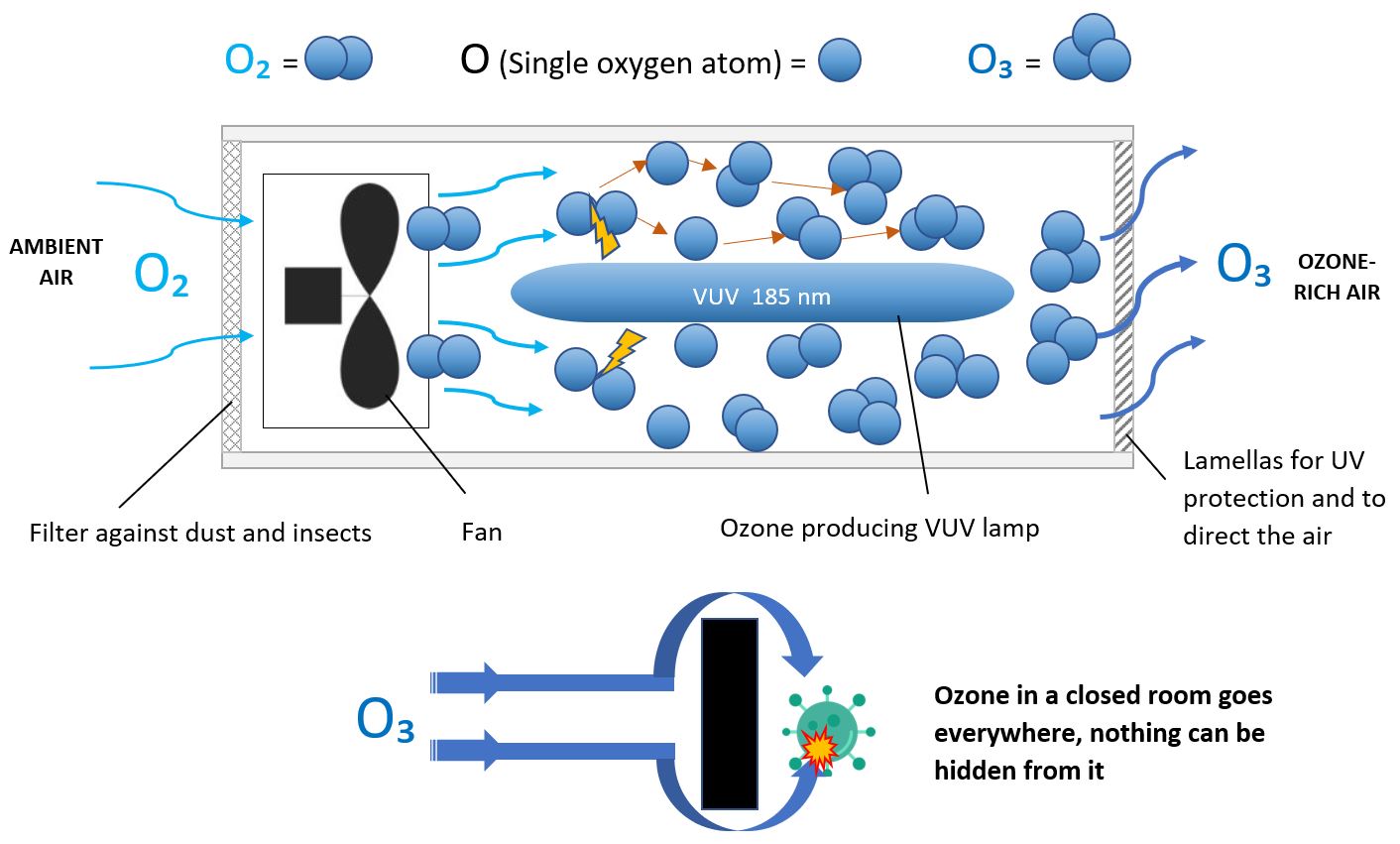
Oxygen atoms (O) are formed during photolysis, when UV radiation in a vacuum at 185 nm breaks down oxygen molecules (O₂) into two oxygen atoms. These then easily combine with an oxygen molecule (O₂), forming a triatomic oxygen molecule (O₃), i.e., ozone. Ozone is an unstable molecule due to the weak bond holding the third oxygen atom. This instability makes ozone a powerful oxidizing, disinfecting, and deodorizing agent. The effect occurs when ozone molecules come into contact with oxidizable substances, including microorganisms, viruses, bacteria, mold spores, and organic and inorganic compounds. Some examples of ozone’s deodorizing effect:
Formaldehyde (CH2O) as a factor in “sick building syndrome”: CH2O + 2O3 = CO2 + H2O + 2O2
The smell of rotten eggs (hydrogen sulfide H2S): H2S + O3 = SO2 + H2O
Toilet odor (ammonia NH3): 2NH3 + O3 = 3H2O + N2
The radiation spectrum of VUV lamps (185 nm + 254 nm) not only enables ozone production but also has a powerful germicidal effect—that is, it acts as a disinfectant and bactericide—when emitting at 254 nm. The combined synergistic effect of 185 nm and 254 nm radiation is highly significant in terms of destroying bacteria and viruses.
After the ozone is introduced into the room to be treated and the programmed treatment process is complete, the ozone-generating lamps automatically shut off, leaving only the fans running to help break down any residual ozone that was not used during the treatment. The ozone produced by the R-FILTER device, if not consumed during treatment operations, quickly reverts to its natural form of oxygen (O2) with a half-life of 30–50 minutes and leaves no harmful residues. The higher the temperature and humidity in the room to be treated, and the more dynamic the airflow, the shorter the half-life and the sooner we can re-enter the treated room.
After the treatment is complete, the device continues to run the fans for 4 hours, thereby helping to break down any residual ozone that was not used in the treatment process. If you enter the treated room after this, you must ventilate it immediately.
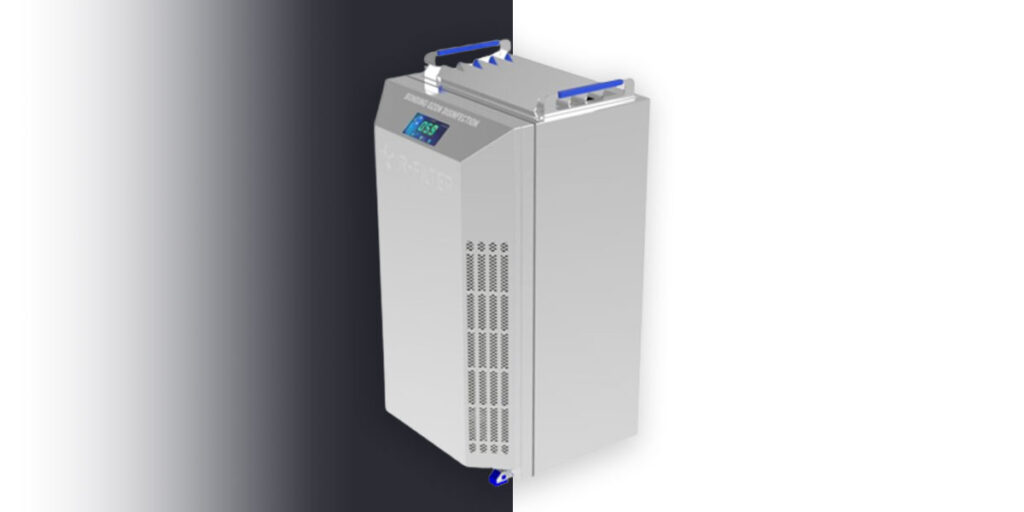
Advantages of using the device:
- effectively disinfects and sterilizes all surfaces and the air
- automatic ozone decomposition cycle
- adjustable program to room size (up to 1000 m3)
- combined effect of ozone and photolysis
- unlike similar devices, does not produce nitrogen dioxide
- operates even in high humidity conditions
- portable device
- cost-effective
- minimal maintenance requirements, chemical-free disinfection